As cases of COVID-19 continue to escalate, those assisting communities continue to forge ahead. As they work tirelessly to continue to support, feed and protect communities, Mastercard has committed 120,000 free trips and meals to those supporting communities across the Middle East and Africa, which will be facilitated through Uber.

Uber is utilizing their technology and making available their wide network of drivers to ensure those who are supporting communities and the many frontline workers who need to be mobile, have a reliable and efficient way of getting around. Once qualifying workers have successfully signed up through Uber’s website, they can arrange transportation to and from their homes and to where they are needed, such as healthcare facilities or to feed the vulnerable. Uber has shared relevant health information with drivers to ensure they are well-informed in COVID-19 related safety protocols and have been provided with masks and sanitizer reimbursements.

Mastercard is helping people around the world navigate these challenging times. While ensuring that its network remains secure, resilient and reliable, Mastercard is also applying its technology, philanthropy, and data science expertise to rebuild healthy communities and ensure that economic growth is inclusive. As millions of people across the world come together to support, feed and protect their communities, Mastercard is extending its support to help those who help others.  

This strategic partnership between Mastercard and Uber spans across the region and through key partnerships will aim to support cities, hospitals, front line workers and marginalized communities with free rides.

Amnah Ajmal, Executive Vice President Market Development, Mastercard, MEA explains, “Mastercard continues to partner with digital players across the value chain to build a more connected world by supporting our communities. With our partner Uber, we are committed to support healthcare and essential workers who are working tirelessly to take care of us. Uber’s mission to improve lives is matched with Mastercard’s mission of doing well by doing good, together we are focused on helping frontline workers across the region feel confident and safe with access to free transportation.”

Anthony le Roux Regional General Manager, Uber, Middle East and Africa, “It is our role to help the society by providing relief, especially those who work tirelessly to support our communities. This is the largest partnership for us across MEA and we are amazed at Mastercard’s relentless effort to make a difference. We are proud to be working alongside them to ensure those supporting our communities, especially those on the frontline, have access to safe and reliable transport.”

This is just a start and this commitment comes as part of Uber’s global pledge to help communities in need to “Move What Matters”.

Further initiatives from Uber in Africa:

  • Kenya: Uber has teamed up with The Nairobi Hospital and Gertrude’s Children’s Hospital to provide trips at a discounted fee to ease movement for medical professionals, ensuring that frontline workers have a reliable and efficient way of getting to and from where their services are required. To support the Kenya COVID-19 Emergency Response Fund, Uber has provided free trips and free deliveries from Uber Eats as they coordinate all coronavirus efforts in the country. Uber will also provide free rides to the National AIDS and STI Control Programme (NASCOP) and Ministry of Health staff.
  • Ivory Coast: Uber has partnered with Ivorian Ministry of Health and SOCIDA, Ivory Coast’s leading automobile dealers and distributors of the Renault, Suzuki, Isuzu and HELI brands, to provide free transportation to health workers in Abidjan.
  • Nigeria: Uber has partnered with the Ministry of Humanitarian Affairs, Disaster Management & Social Development (MHA) in Nigeria to provide food packages to school children within Lagos and Abuja. The partnership will effectively mobilise transportation of needed food parcels to over 260 identified food banks, to bring necessary relief and support for up to 70 000 households via the foodbank distributions. This allows over 3 million school kids to be fed, while further supporting governmental response teams towards curbing the outbreak. 
  • Ghana: Uber is supporting FreeLunchGH and The Safe Space Foundation with free rides.

For information as to how Relocation Africa can help you with your Mobility, Immigration, Research, Remuneration, and Expat Tax needs, email info@relocationafrica.com, or call us on +27 21 763 4240.
Sources: [1], [2]. Image sources: [1], [2].

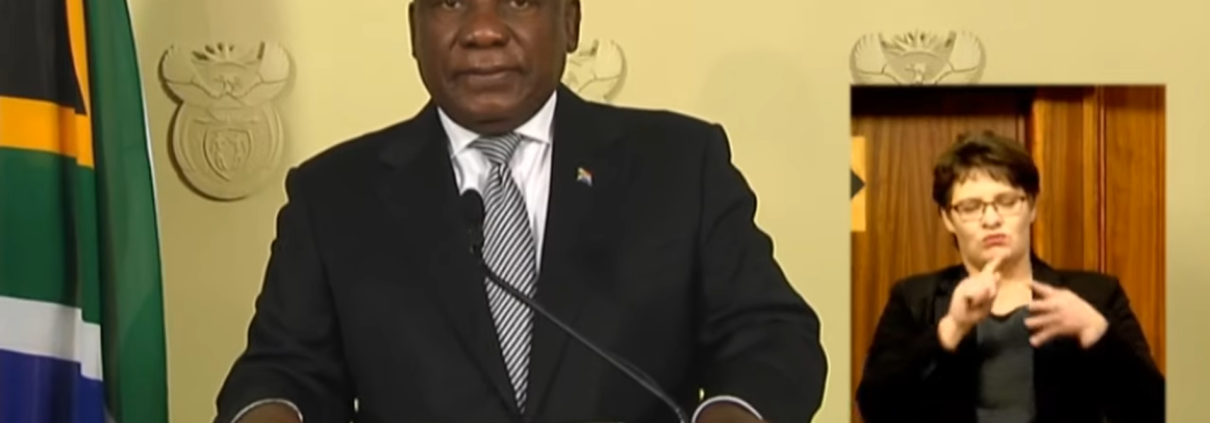
President Cyril Ramaphosa has announced the reintroduction of a number of lockdown restrictions as the country grapples with rising coronavirus cases.

In a national address on Sunday evening (12 July), Ramaphosa said that the country is now expecting a surge of infections and that the ‘storm is now upon us’.

He noted that the country has reported a total of 260,242 confirmed cases, with more than 12,000 new cases being reported every day. This means that there are effectively 500 new cases being reported every hour.

He added that more than 4,079 fatalities have been reported in the country to date. The president said that Gauteng is fast approaching 100,000 cases, while the Eastern Cape is approaching 50,000 cases. The Western Cape is soon set to hit 80,000 cases.

He said that the country’s provinces will see different ‘peaks’ in coronavirus cases between the end of July, to September.

“While the surge in infections is expected, the force and speed which they have progressed have quite understandably caused concern amongst us,” he said.

“The coronavirus storm is far fiercer and more destructive than any other we have experienced before.”

Restrictions

While most South Africans have taken steps to limit the spread of the coronavirus, president Ramaphosa said that there are some that continue to ignore regulations, and have failed to take steps to protect themselves and others.

This includes people who have organised parties and fail to wear masks in public places. The president said that there have also been a number of funerals with more than 50 people.

To this end, Ramaphosa said that the country’s National coronavirus Command Council deliberated on whether to return all or parts of the country to a higher lockdown level.

However, it noted that this was unlikely to decrease the number of coronavirus cases, while causing untold harm to the economy.

Instead, Ramaphosa said that government will be ‘tightening’ existing regulations including:

  • The country will remain at lockdown level 3;
  • The wearing of cloth masks will be mandatory including stricter rules around the wearing of masks at workplaces and while travelling. Further regulations on this issue are set to be gazetted at a later date;
  • Taxis taking long trips will have to adhere to 70% occupancy. Taxis taking shorter trips may increase capacity to 100%, subject to strict health protocols;
  • The sale, dispensing and distributing of alcohol has been suspended with immediate effect;
  • A curfew will be put in place between 21h00 and 04h00, except for people who travel for work, or require urgent medical assistance. This curfew will come into effect from Monday (13 July);
  • Parks will be opened for exercise, but will not be allowed for gathering purposes;
  • Family visits and other social visits will remain prohibited.

President Ramaphosa added that the national state of disaster has been extended to 15 August as part of these new lockdown measures.

To read the President’s full speech, click here.

For information as to how Relocation Africa can help you with your Mobility, Immigration, Research, Remuneration, and Expat Tax needs, email info@relocationafrica.com, or call us on +27 21 763 4240.

Sources: [1], [2]. Image sources: [1], [2].

The Department of Tourism presented its revised budget in parliament on 9 July, highlighting how the coronavirus pandemic and the national lockdown have caused massive damage to the industry.

Addressing parliament’s tourism portfolio committee, Tourism minister Mmamoloko Kubayi-Ngubane, said that while easing lockdown regulations in the sector was aimed at assisting businesses, it had to be done under strict conditions, and while reinforcing government’s health objectives towards defeating Covid-19.

The minister added that her department’s focus will be on supporting domestic tourism as the first point of recovery.

However, she caution cautioned that the recovery of the entire tourism industry would largely depend on how travel-ready authorities are in terms of managing and controlling coronavirus locally and globally.

The below graphic, taken from the department’s presentation, shows how tourism and the aviation sector is likely to open up in South Africa.

The department did not provide information on when these phases are likely to be introduced – noting again that they were heavily dependent on aviation regulations. However, it made it clear that it will focus on ‘domestic tourism first’.

“Tourism recovery will experience a number of phases, from hyper-local community attractions, through broader domestic tourism, regional land and air markets, and lastly resumption of world-wide international travel.

“The phases may not necessarily follow the same sequence but of certain is domestic tourism first.”

Tourism director-general, Victor Tharage, confirmed that the department lost close to R1 billion in its readjusted budget as announced by finance minister Tito Mboweni.

However, Tharage said that although there were difficult times ahead for the industry and those dependent on it, his department would still be able to meet all its amended targets in line with its adjusted budget.

Travel

At the end of June, Transport minister Fikile Mbalula announced that a number of air travel restrictions will be eased as part of the country’s move to ‘advanced’ level 3.

Mbalula said that this will include the reopening of a number of domestic air routes, as well as general relaxations around the industry.

The airports include:

  • Bram Fischer International Airport (Bloemfontein);
  • Kruger Mpumalanga International Airport;
  • Pietermaritzburg Airport;
  • Port Elizabeth International Airport;
  • Richard’s Bay Airport;
  • Skukuza International Airport.

OR Tambo International, Cape Town International, King Shaka International airport, and Lanseria have been open since the start of the June.

South Africans are currently only allowed to fly domestically for business purposes, with international travel only allowed for repatriation and medical evacuations.

For information as to how Relocation Africa can help you with your Mobility, Immigration, Research, Remuneration, and Expat Tax needs, email info@relocationafrica.com, or call us on +27 21 763 4240.

Sources: [1], [2]. Image sources: [1], [2].

The Department of Basic Education (DBE) has published a new directive which outlines the new return dates for South African schools.

The directive, which was gazetted on Tuesday (7 July), further splits the return of pupils with some students now set to return as late at 31 August.

These new dates are detailed in the table below.

The directive also makes provision for provinces which are unable to comply with the new start dates.

In these cases, the DBE said that if a MEC responsible for education in a province must, at least seven days before the date identified for the return of the respective grades, submit a report to the Minister for concurrence or further determination.

The report must include:The reasons for the non-compliance; and
A plan with the proposed dates for the phased return of learners and officials in the respective grades. You can read the full directive by clicking here.

For information as to how Relocation Africa can help you with your Mobility, Immigration, Research, Remuneration, and Expat Tax needs, email info@relocationafrica.com, or call us on +27 21 763 4240.

Sources: [1], [2]. Image sources: [1], [2].