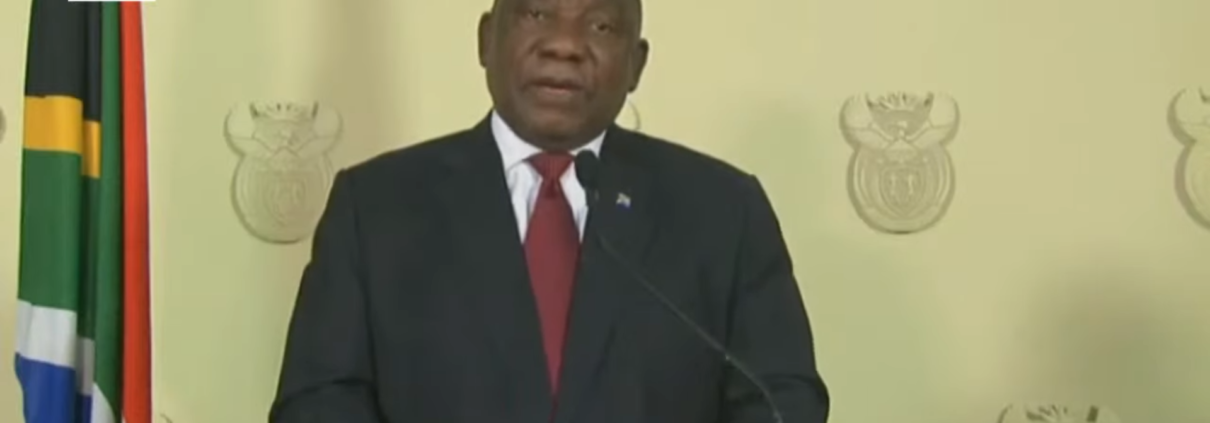
President Cyril Ramaphosa announced South Africa will be moving to Level 3 lockdown by the end of May, with certain areas most affected by the coronavirus outbreak remaining at Level 4.

In a televised address, Ramaphosa said the next phase of the country’s coronavirus response, as people returned to work, would “in many ways be more difficult than the present one”.

He added the coronavirus would continue to be a global health threat for some time to come, and the fight against it needed to become part of South Africans’ daily lives.

South Africa would have seen 80 000 infections already without lockdown  

Without a national lockdown, South Africa would have seen 80 000 infections by now, Ramaphosa said. The national lockdown was, therefore “absolutely necessary” to help the authorities prepare. 

He said while South Africa mourned the loss of 219 lives due to the virus, the number of deaths would have been eight times higher without the lockdown.

He said by the time the US had a similar stage of the disease, it had recorded 22 000 deaths and the UK more than 19 000.

Without the lockdown, Ramaphosa added, South Africa’s health facilities would have been overwhelmed and many thousands more people would have died.  

Around 181 people per million have been infected by the virus 

South Africa’s positivity rate, the percentage of cases identified out of all the tests conducted, had remained low, he said. 

Ramaphosa added the number of confirmed infections in South Africa was around 181 people per million of the population.

By contrast, he said, countries such as the US, the UK, Spain, Italy and Singapore have between 2 400 and 4 600 coronavirus cases per million people.

“It is significant that out of the 12 074 confirmed cases in South Africa, we have recorded 4 745 recoveries.” 

South Africa now has 25 000 additional beds for quarantine

Ramaphosa said by delaying the spread of the virus, South Africa was able to strengthen the health system’s capacity by increasing the number of beds available for quarantine by 25 000.

He added the lockdown had helped the country to source and produce substantial quantities of personal protective equipment for health workers, vital medical equipment and other supplies.

Ramaphosa thanked the US for a donation of 1 000 ventilators that will assist in treating serious coronavirus patients.

Over 9 million South Africans have been screened, 370 000 tested

In what is the country’s largest and most extensive public health mobilisation, Ramaphosa said fieldworkers have screened more than nine million people, and nearly 370 000 coronavirus tests have been completed.

“It has been made possible by the hard work and dedication of thousands of community workers, nurses, doctors and other health workers,” he added. “They made enormous sacrifices to ensure the success of the lockdown.” 

UIF paid out over R11bn to 2 million employees

Ramaphosa said the special Covid-19 relief fund of the Unemployment Insurance Fund (UIF) had paid out more than R11 billion to two million employees employed by over 160 000 companies in distress since it was launched.

He added the government’s various funds have supported more than 27 000 small businesses since they were launched.

The government’s R200 billion Covid-19 loan guarantee scheme, which is part of the R500 billion relief package, has also started to process applications from small- and medium-sized businesses on Wednesday.

Around 3 million South Africans applied for Covid-19 grant

Some three million people have applied for the Covid-19 grant of R350 per month for unemployed South Africans who received no other form of assistance from the government, Ramaphosa said.

He added an additional R5 billion have also been paid out to social grant recipients at the beginning of May to assist poor households.

Level 3 lockdown for most of South Africa by end of May

Ramaphosa said a consultation process would start with relevant stakeholders to place most of the country on Level 3 lockdown by the end of May.

Parts of the country with the highest rates of infection will, however, remain on Level 4 lockdown. 

Infections were for now mostly concentrated in a few metropolitan municipalities and districts in the country, Ramaphosa said.

“I will repeat what I have said before: If we lift the lockdown too abruptly and too quickly, we risk a rapid and unmanageable surge in infections,” he added.

Level 3 lockdown will see the return of alcohol sales between 08:00 and 12:00 between Mondays and Wednesdays, limited domestic air travel, and all clothing and textiles sales, under draft rules.

Level 4 lockdown regulations will change

The government would in the coming days announce certain changes to Level 4 regulations to expand permitted business activities in the retail space and e-commerce and reduce restrictions on exercise, Ramaphosa said.

Some lockdown regulations have been unclear and contradictory

He added some of the lockdown regulations decided upon by the government have been unclear, some have been contradictory and some have been poorly explained.

Ramaphosa said implementation had sometimes been slow and enforcement had sometimes been inconsistent and too harsh.

“This evening, I want to reaffirm my commitment and the commitment of the government I lead to take whatever action is necessary to safeguard the life, the dignity and the interests of the South African people.

“Where we have disappointed, we will continue to make amends. Where we make mistakes, we will continue to correct them.”

View the full address below.

For information as to how Relocation Africa can help you with your Mobility, Immigration, Research, Remuneration, and Expat Tax needs, email info@relocationafrica.com, or call us on +27 21 763 4240.

Sources: [1], [2]. Image sources: [1], [2].


The coronavirus and the lockdown have disrupted almost all forms of daily life – and are likely to have an impact on next year’s local government elections.

While there is no formal public discussion as yet about whether the 2021 local government elections will be postponed, it is possible there will be some material disruption. The dynamics of our politics leading up to those polls will be affected by the government’s response to the Covid-19 pandemic, and how the lockdown plays out.

So far, no national government or electoral official has said that the polls will be postponed. But already by-elections for councillors in different parts of the country have been delayed. 

The five-year term of the current council administration ends in early August 2021. Legally, a new election must be held within 90 days on either side of the last election date — 3 August 2016 was the last municipal poll — which takes the latest possible deadline to the start of November 2021.

If an election can not be held by that time, it would be a first in democratic South Africa’s electoral history. Parliament may be asked to consider an intervention to allow for special circumstances. 

While the Municipal Structures Act allows the co-operative governance minister to set an election date after consultation with the Electoral Commission of South Africa (IEC), that date must fall within the 90-day window. And although the Local Government Municipal Elections Act allows for the postponement of an election, that delayed date must still fall within that 90-day window.

Some parties may want a delay, others may not, and that could lead to more political problems and friction.

Another option is for the Constitutional Court to be asked if it can authorise an election outside the constitutional timeframe. This may be a quicker and easier option. 

But it may pose a problem for the ConCourt. 

Judges are not supposed to “make law” but to interpret law. To allow, or authorise a late election would surely be seen as “making law”. To postpone a constitutionally mandated election is a very significant decision. Judges may well feel that they don’t have the power to do so, as this would be  Parliament’s responsibility.

A third possibility is that an application to the high court could be made. 

Either way, all of the political parties registered at the IEC would get the chance to make their arguments. But if that were to happen, and just one party to the case were unhappy with the outcome, it would end up in the Constitutional Court anyway. 

All of this has the potential for very real discord and multiple frictions. Other arguments could come into it, including the long-running debate in the ANC about whether local elections should become a part of the national and provincial elections. 

(It’s hard to know where the ANC is on this at the moment. When he was secretary-general, Gwede Mantashe said that elections every 2½ years would help to keep the party unified.)

Current events will have an important impact on the campaigns leading up to the elections, and on the final results.

In 2016, famously, the ANC lost outright control of Joburg, Tshwane and Nelson Mandela Bay. There is enough evidence that one of the main drivers for this was not only the state of those cities (although it must have played an important role) but national politics. The figure of Jacob Zuma, as president at the time, hung over that election and its results. Who could ever forget the sight of four young women standing in front of  Zuma as the results were being declared, holding up placards asking people to remember the woman he was accused (and acquitted) of raping? 

The world and our politics appear to be moving faster than ever. Vladimir Lenin’s dictum that “there are decades when nothing happens; and there are weeks when decades happen” did not feel more true than, well, in decades. That said, it seems reasonable to assume that it is possible these elections will be seen as a referendum on the government’s response to the coronavirus. 

They will, in some ways, be a judgment of the lockdown and whatever further transpires.

This may prove a difficult terrain for all parties. If the economic damage caused by the lockdown matches the projections (which range from the Reserve Bank’s prediction of a 6.2% contraction in GDP to Business for SA’s suggestion of a 17% contraction) everyone will be poorer. And angry. And frustrated.  

The vote could turn into a protest against “all parties as we know them”. 

As people become hungry, tensions between different groups will rise. There are already signs that this is happening as different views on the lockdown emerge. By then, these tensions could be much more stark.

Elections have a tendency of magnifying differences between people, and politicians tack to certain constituencies. If the middle classes continue to criticise Co-operative Governance Minister Nkosazana Dlamini Zuma, for example, the claim that these attacks are based on racism and not on her expertise/delivery could gather steam. This would make the elections more difficult than those in the past.

It is also possible that an election is held that raises social tensions and results in a very low poll. This may be legally legitimate, but not in the national interest.

At the same time, the ANC might be concerned that as the more establishment party, the one in power, it could lose the elections. The DA may feel it has not had time to fully sort out the internal differences (both its policy conference and its leadership conference have been postponed). The EFF has been almost silent during the lockdown and may believe it would struggle to regain any momentum it has lost. 

Hence, the three major parties may not oppose a postponement of the polls.

However, that won’t solve many of the problems that exist in the local government sphere. 

There have been moments of complete chaos in three of the big metros. Joburg is run by the ANC, but only just, after Herman Mashaba’s resignation as mayor. The ANC-governed province of Gauteng took over the DA-led administration in Tshwane, before a court overruled that decision. Nelson Mandela Bay still has an acting mayor and saw a collapse in services during the time that the UDM’s Mongameli Bongani was mayor. It is also about to run out of water.

Any delay in elections means all of those problems remain. The sooner all of this is resolved the better.

For information as to how Relocation Africa can help you with your Mobility, Immigration, Research, Remuneration, and Expat Tax needs, email info@relocationafrica.com, or call us on +27 21 763 4240.

Sources: [1], [2]. Image sources: [1], [2].

The South African Revenue Service (SARS) has outlined changes to the coming tax filing season due to the impact of the coronavirus.

In a presentation recently, SARS commissioner Edward Kieswetter said that the season will be comprised of three phases with a number of key changes being made.

Below he outlined the phases and what will be expected of taxpayers and companies over each period.


Phase  1 – Employer filing

15 April 2020 – 31 May 2020

Kieswetter said that compliance by employers in respect of payroll taxes (PAYE) is very important, and that there will be a renewed focus at SARS to ensure that all employers are fully compliant in terms of their filing and payment obligations.

“We expect all employers to fully comply because this ensures a much lower burden of compliance for their employees in respect of their filing obligations.

“Employers are legally appointed agents on behalf of SARS. We remind employers that it is a criminal offence to collect income tax from their employees, and not pay this over to SARS.

“We also appeal to employers, along with other providers of third-party information to fulfil this requirement by the end of May 2020.”

Kieswetter said that third-party Information allows us to use data modelling and artificial intelligence to perform the final assessment of all standard taxpayers and provide the majority of individual taxpayers with a seamless filing experience.

Third-party providers include:

  • Employers;
  • Banks;
  • Financial Service Companies who administer retirement fund and pension schemes;
  • Medical Savings and insurance schemes.

Phase 2 – Tax file updates1 June – 31 August 2020

During this period taxpayers are requested to engage with SARS to ensure that their tax files are up to date, in terms of general hygiene checks, banking details, address changes, Kieswetter said.

He added that most of these tasks can be completed online.

“All outstanding third party information will also be followed up during this period to ensure the highest level of data integrity. Third-party data providers, including employers, who remain wilfully non-compliant will be charged criminally during this period.

“During this phase a significant number of taxpayers will receive auto-assessments and given an opportunity to confirm their acceptance of the assessment outcome according to SARS.”

Kieswetter added that during phase 2, individual taxpayers who are required to file but have not been auto-assessed may file early via online facilities if their employers and other third-party data providers are fully complaints (which includes no PAYE debt without a proper and secure deferment arrangement).

Individuals who are not required to file will be informed, he said.


Phase 3 – Employee filing 

1 September – 31 January 2021

Kieswetter said that during this phase, individuals who are required to file will be reminded.

“Individuals who are non-provisional taxpayers or have not accepted the outcome of an auto-assessment are required to file as from 1 September through to 16 November 2020 and encouraged to file using our on-line channels to minimise visits to our offices.

“Individuals who are non-provisional taxpayers, who make use of our Branch facility has until the 22 October 2020 to file.

“Provisional Taxpayers who have not accepted the outcome of an auto-assessment are required to file when they are ready but not later than 31 January 2021.”

For information as to how Relocation Africa can help you with your Mobility, Immigration, Research, Remuneration, and Expat Tax needs, email info@relocationafrica.com, or call us on +27 21 763 4240.

Sources: [1], [2]. Image sources: [1], [2].

South Africans can move house again, as long as the country does not go back up to Alert Level 5.

Under regulations published by cooperative governance and traditional affairs (Cogta) minister Nkosazana Dlamini-Zuma, people and their household effects may move around South Africa on a once-off basis – even across provincial lines.

But there are terms and conditions – including that any move must happen by 7 June.

The rules are intended to allow people to move when they have entered a new lease agreement, either before or during lockdown, or where they have bought new homes and the transfer of the property has already gone through.

In those cases, once-off relocation is allowed. But there are strict limits.

You may only move “household furniture and effects” as required to move into a new home.

For now, at least, there is also a specific window for moves, similar to the just-closed window for those who needed to change provinces to go back to work. That window is open from Thursday, 7 May, and will close again on 7 June if the lockdown level is not relaxed or new rules are not issued before then.

If you are moving between towns, you’ll also need permission from the police. Travel “across provincial, metropolitan or district boundaries” require a permit issued by a station commander, Dlamini-Zuma said.

You need to have that permit, plus a signed lease or transfer documents to hand during travel.

(Compiled by Phillip de Wet).

For information as to how Relocation Africa can help you with your Mobility, Immigration, Research, Remuneration, and Expat Tax needs, email info@relocationafrica.com, or call us on +27 21 763 4240.

Sources: [1], [2]. Image sources: [1], [2].