Tag Archive for: SA Government

Lynn Mackenzie, J.D., LLM
Courtesy of Linda Ensor

The special permit and visa dispensation introduced to address the difficulties arising from the Covid-19 lockdown has been extended to end-October, home affairs minister Aaron Motsoaledi announced recently.

The dispensation, which allowed for people to continue staying legally in SA despite the expiry of their visas and permits, was due to expire at end-July. It was introduced because the lock-down prevented the movement of people to renew their visas and permits and also because visa offices were closed.

Motsoaledi announced the extension in his budget vote speech in the National Assembly. He said regulations providing for it would be promulgated soon and definitely before the end of July. He noted that the Covid-19 situation had not changed much.

Motsoaledi also called on parliament to address the question of whether the local government elections should be held on the same day as the national and provincial elections. Political parties must decide on this issue and “the sooner the better”, he said.

He noted that the Independent Electoral Commission had established addresses for 24-million (90,5%) of the more than 26-million registered voters on the voters’ roll. “This is a phenomenal improvement given that in 2016 when we went into the local government election only 8.6-million complete addresses were present on the voters’ roll.”

The obligation to secure addresses for voters was a consequence of a Constitutional Court ruling. The minister gave the assurance that the 1.2-million voters now without an address would not be deprived of the right to vote. An amendment to the Electoral Act would be introduced to provide for a valid voting mechanism for these voters. It would give the voting station as their address just before voting.

Motsoaledi also gave the assurance that the ruling ANC would honor the Constitutional Court ruling that the electoral system must be changed to allow independent candidates to stand for election. He said the amendment to the electoral system would afford an opportunity to cure all the ills in the electoral regime.

The content of this article is provided for general information purposes. The provision of this article does not constitute legal advice or opinion of any kind; no advisory or fiduciary relationship is created between Relocation Africa and any other person accessing or using this article . Relocation Africa will not be liable for any damages or loss arising from using any part of this article .

For information as to how Relocation Africa can help you with your Mobility, Immigration, Research, Remuneration, and Expat Tax needs, email info@relocationafrica.com, or call us on +27 21 763 4240.

Sources: [1], [2]. Image sources: [1], [2].

Health Minister’s plea to South Africans

Health minister Dr Zweli Mkhize has delivered an ‘urgent and important’ plea to all South Africans around the country’s flagging response to the Covid-19 pandemic.

“As Government, we have mobilized every resource, every faculty and wherewithal at our disposal to effect the necessary interventions. But government cannot manage this unilaterally.

“Every single South African now needs to focus on adhering to recommendations pertaining to non-pharmaceutical interventions,” he said.

“We are extremely concerned that fatigue seems to have set in and South Africans are letting down their guard at a time when the spread of infection is surging. We see poor or no social distancing in communities.

“Masks are being abandoned or not worn properly and there is laxity setting in around frequent hand-washing.”

The minister said that this will directly influence the rise in numbers in the next two weeks. “We must all appreciate that there is a direct causal link between the surge of cases and our ability, or inability, to ad- here to these very basic principles.

“We do not have a vaccine. We do not have a cure. Our ability to break the cycle of infection depends on our willingness to remain focused and disciplined and take non-pharmaceutical interventions seriously.

“We can beat this pandemic together. We have already proved this during the lockdown,” he said.

“It remains in each and every citizen’s hands to admonish family members, colleagues, friends. who refuse to adhere to measures that protect lives by limiting the spread of this virus.”

Case numbers soar

South Africa is now ranked 5th in the world for the most COVID cases. You can view the Microsoft case number tracker here.

Before this article was originally published (July 20, 2020), the minister announced that there were a total of 350,879 cases of coronavirus in South Africa.

An update: as at July 31, 2020, cases in SA stand at 482,169.

Quarantine recommendations

Mkhize also published a new directive which details the self-isolation and quarantine criteria that should be followed for people returning to South Africa.

In the context of the regulations, these criteria are specific to people re-entering the country from abroad. However, they also provide clarity around what is expected of people who are self-isolating at home.

These criteria include the following:

  • A separate well-ventilated bedroom with a bathroom and toilet, or a residence that is not shared with persons who are not subject to quarantine;
  • Meals should be served in the room in disposable utensils or utensils that are separate and are washed properly if there are persons who are not subject to quarantine;
  • Support from friends or family that can facilitate the drop off of food and medicine at the gate if they are not able to make use of online shopping facilities and contactless deliveries;
  • A thermometer that will allow him or her to measure his or her temperature daily;
  • Access to the internet and a phone that allows the daily reporting of symptoms;
  • Access to a private physician that he or she can contact should he or she require medical advice or care; and
  • A contact number where he or she can be reached during the period of self – quarantine or self -isolation.

For information as to how Relocation Africa can help you with your Mobility, Immigration, Research, Remuneration, and Expat Tax needs, email info@relocationafrica.com, or call us on +27 21 763 4240.

Sources: [1], [2]. Image sources: [1], [2].
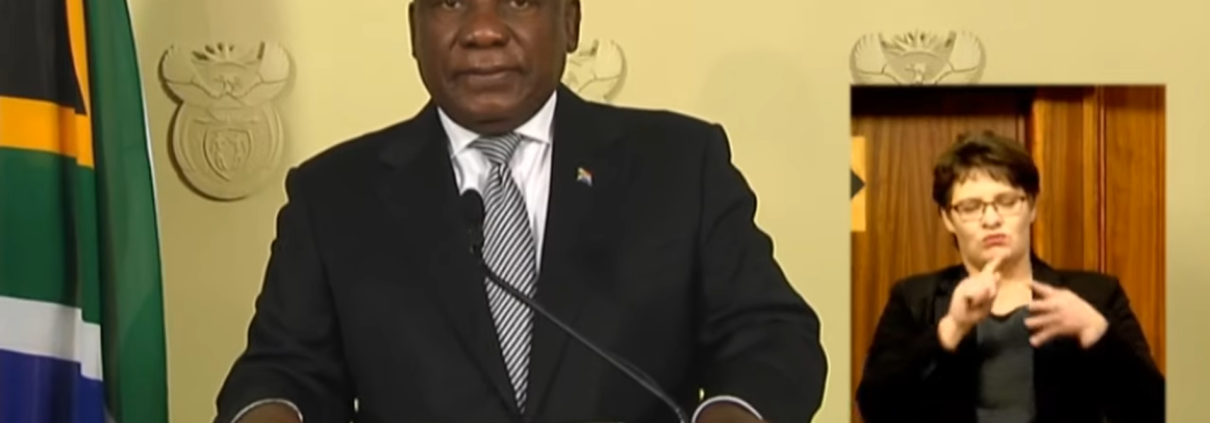
President Cyril Ramaphosa has announced the reintroduction of a number of lockdown restrictions as the country grapples with rising coronavirus cases.

In a national address on Sunday evening (12 July), Ramaphosa said that the country is now expecting a surge of infections and that the ‘storm is now upon us’.

He noted that the country has reported a total of 260,242 confirmed cases, with more than 12,000 new cases being reported every day. This means that there are effectively 500 new cases being reported every hour.

He added that more than 4,079 fatalities have been reported in the country to date. The president said that Gauteng is fast approaching 100,000 cases, while the Eastern Cape is approaching 50,000 cases. The Western Cape is soon set to hit 80,000 cases.

He said that the country’s provinces will see different ‘peaks’ in coronavirus cases between the end of July, to September.

“While the surge in infections is expected, the force and speed which they have progressed have quite understandably caused concern amongst us,” he said.

“The coronavirus storm is far fiercer and more destructive than any other we have experienced before.”

Restrictions

While most South Africans have taken steps to limit the spread of the coronavirus, president Ramaphosa said that there are some that continue to ignore regulations, and have failed to take steps to protect themselves and others.

This includes people who have organised parties and fail to wear masks in public places. The president said that there have also been a number of funerals with more than 50 people.

To this end, Ramaphosa said that the country’s National coronavirus Command Council deliberated on whether to return all or parts of the country to a higher lockdown level.

However, it noted that this was unlikely to decrease the number of coronavirus cases, while causing untold harm to the economy.

Instead, Ramaphosa said that government will be ‘tightening’ existing regulations including:

  • The country will remain at lockdown level 3;
  • The wearing of cloth masks will be mandatory including stricter rules around the wearing of masks at workplaces and while travelling. Further regulations on this issue are set to be gazetted at a later date;
  • Taxis taking long trips will have to adhere to 70% occupancy. Taxis taking shorter trips may increase capacity to 100%, subject to strict health protocols;
  • The sale, dispensing and distributing of alcohol has been suspended with immediate effect;
  • A curfew will be put in place between 21h00 and 04h00, except for people who travel for work, or require urgent medical assistance. This curfew will come into effect from Monday (13 July);
  • Parks will be opened for exercise, but will not be allowed for gathering purposes;
  • Family visits and other social visits will remain prohibited.

President Ramaphosa added that the national state of disaster has been extended to 15 August as part of these new lockdown measures.

To read the President’s full speech, click here.

For information as to how Relocation Africa can help you with your Mobility, Immigration, Research, Remuneration, and Expat Tax needs, email info@relocationafrica.com, or call us on +27 21 763 4240.

Sources: [1], [2]. Image sources: [1], [2].

The Department of Basic Education (DBE) has published a new directive which outlines the new return dates for South African schools.

The directive, which was gazetted on Tuesday (7 July), further splits the return of pupils with some students now set to return as late at 31 August.

These new dates are detailed in the table below.

The directive also makes provision for provinces which are unable to comply with the new start dates.

In these cases, the DBE said that if a MEC responsible for education in a province must, at least seven days before the date identified for the return of the respective grades, submit a report to the Minister for concurrence or further determination.

The report must include:The reasons for the non-compliance; and
A plan with the proposed dates for the phased return of learners and officials in the respective grades. You can read the full directive by clicking here.

For information as to how Relocation Africa can help you with your Mobility, Immigration, Research, Remuneration, and Expat Tax needs, email info@relocationafrica.com, or call us on +27 21 763 4240.

Sources: [1], [2]. Image sources: [1], [2].