A young Gambian man has taken it upon himself to tell about his horrific experiences in China, in hope that it will inspire other Africans.
Every so often, stories of migrants perishing at sea or in other forms of transport all in the name of searching for greener pastures across the borders hit our media.

Just recently, bodies of nineteen Ethiopians were found in the back of a Zambian container truck, having suffocated to death. 76 more were found alive inside the container truck and are believed to have been on their way to South Africa. In May more than 700 people perished at sea as the boat they were traveling in from Libya to Italy capsized and killed the hundreds.

These are just but some of the heart-wrecking stories of migrants, who perish on their way to safer havens which they never reach. Some people, however, reach the other side, and the greener pastures they allegedly saw from a distance is not as green or as real.

Then, these people have to embark on a life of struggling to survive every day; searching for jobs to sustain themselves in a foreign land and saving a little to send back home. Those that are lucky get jobs and are able to stay on, others, go through worse experiences than they did in their home countries. With no job or money to survive abroad, they opt to return home. Some don’t even have enough to buy a ticket back home. They call for help from the same people they ought to be helping.

Source

Traditionally, aid and trade with Africa has been subject to various conditions set by the providers. The West has been the main proponent of this idea, advancing the idea that aid and trade cannot come with no strings attached. Africa has called out the West for trying to use aid and trade for purposes of advancing its own political aspirations in Africa. As if deliberately taking advantage of the weakness of the relationship of the West with Africa, China had of late come in with ideas that are in direct opposition to the West’s. Where Western capital attempted to use its financial clout to influence the political future of African countries, China is silent and turns a blind eye. It turns a blind eye even where tyrants rule and oppress their own citizens. Beijing’s one true motivation seems to be getting commodities at the best possible prices and getting a market for its own products. This has been the fuel for the commodity boom which has now been affected by the slowdown in Chinese growth.

All about the money?

A New York University study says trade between Africa and China rose from $10 billion in 2000 to $166 billion in 2011 which translates to a sixteen fold increase. The Aid budget also rose from $1.7 billion in 2001 to a solid $189 billion in 2011. The trade and aid have not been selectively given to the so called “democracies” in Africa; everyone, even the dictators have a fair share. It has been said that, “China is easier to do business with because it doesn’t care about human rights in Africa – just as it doesn’t care about them in its own country. All the Chinese care about is money.”

Source

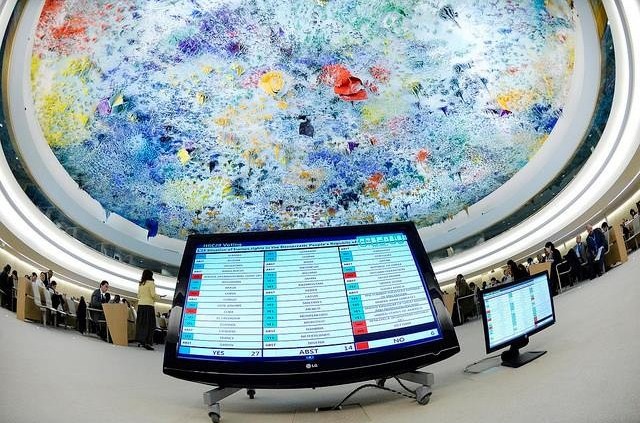
The Human Rights Institute of South Africa has expressed disappointment at the South African vote against a resolution by the United Nations’ Human Rights Council on civil society.

The resolution, aimed at creating safe spaces for civil society to operate, was passed on 1 July with 31 votes for, 7 against, and 9 abstentions.

The resolution, known as A/HRC/32/L.29, was introduced by Chile, Ireland, Japan, Sierra Leone and Tunisia. It was widely supported by civil society around the world; 244 organisations signed an open letter urging members of the Council to vote for the adoption of the resolution, including the Human Rights Institute of South Africa and international organisations such as Amnesty International and Human Rights Watch which have a presence in the country.

The resolution is fuelled by a concern that “in many countries, persons and organizations engaged in promoting and defending human rights and fundamental freedoms frequently face threats, harassment and attacks and suffer insecurity as a result of those activities.”

Source

The Government of Uganda has introduced the online visa application system with effect from
July 1.

Anyone intending to come to Uganda for tourism, business, study, medical or other reasons are required to apply and obtain a visa online. Types of visas that can be applied for online include multiple-entry, diplomatic and official, ordinary, East Africa tourist visa and transit visa.

Applications should be submitted at the following link: https://visas.immigration.go.ug/.

The decision taken on the application will be sent electronically through the email provided by the applicant. If approved, an approval letter will be sent as an attachment to the email provided. Travellers will need to print out the approval letter and present it together with a valid passport/travel document at the port of entry.