The Ministry of Tourism in India will hold a BRICS Convention on Tourism from September 1-2 in Khajuraho Madhya Pradesh as a precursor to the BRICS Summit to be held in Goa on October 15-16.

The convention will comprise inter-governmental exchange of views, panel discussions on technology, innovation in tourism, and co-operation between the BRICS countries for promoting intra-regional tourism.

Arrivals to South Africa from China, India and Brazil account for 11% of the overseas arrivals for the first six months of the year. Statistics for Russia have not been isolated.

Source

The image of Rwandan President Paul Kagame and Chadian President Idriss Déby proudly holding the first two copies of the newly launched pan-African passport at the African Union (AU) summit in the Rwandan capital Kigali this month marked the type of historic moment rarely seen at such gatherings, where outcomes are often measured in declarations or resolutions.

With the launch of the new pan-African document, the continent moved up a notch towards the free cross-border movement of goods and people – in direct contrast to Brexit, the decision by British voters to exit the European Union.

The AU will issue the new biometric or electronic passports only to African heads of state, foreign ministers and diplomats accredited by the AU headquarters in Addis Ababa, Ethiopia. It will bear the AU’s name and that of the issuing country. The plan is for African governments to roll it out to their citizens by 2018.

Many thought the move was well overdue, since one of the AU’s regional trading blocs, the 15-member Economic Community of West African States (ECOWAS), has been offering 90-day visa-free entry to member states’ citizens since the late 1970s.

Visas in Ghana

One sign that the region is making progress in dismantling intra-African trade barriers is that while the AU was launching its new passport, Ghana, a member of ECOWAS, was starting to issue visas upon arrival to citizens of all 54 African countries. Prior to the move, Ghana offered visa-free entry only to ECOWAS citizens.

According to the African Development Bank’s Africa Visa Openness Report 2016, acquiring a visa is a huge challenge for travellers, with Africans still needing visas to travel to 55 percent of other African countries. Only 13 out of 54 countries offer liberal access (visa-free or visa on arrival) to Africans.

Source

  • High cost of healthcare causes dissatisfaction among expats
  • Finding friends is easy, language barrier not a problem
  • Kenya & Nigeria: High job satisfaction despite poor economy and long work weeks
  • South Africa stands out for availability of childcare and education

regional_report_kenya_nigeria_south_africa

Room for Improvement in the Quality of Life Index

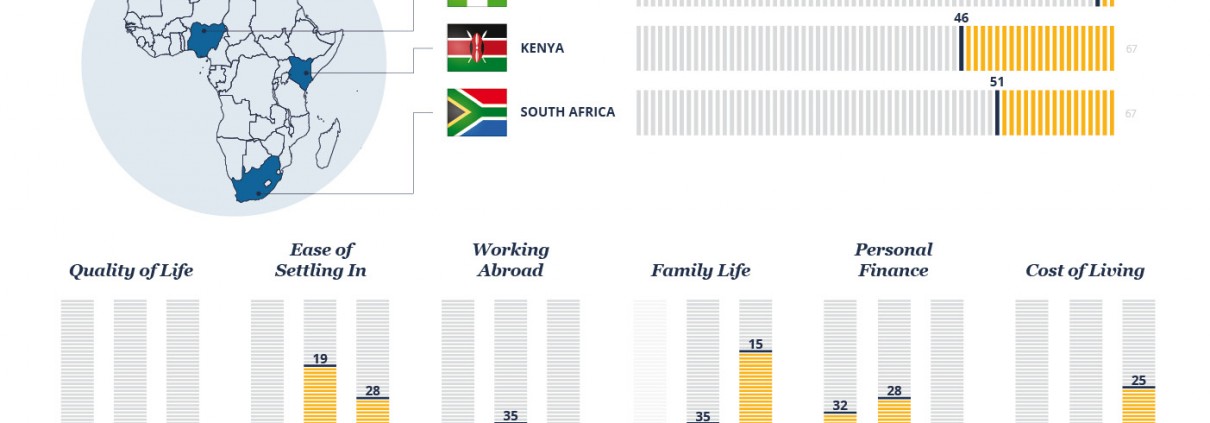
The key African expat destinations are all listed in the bottom ten of the Quality of Life Index: South Africa, Kenya, and Nigeria rank 52nd, 59th, and 67th out of 67 countries, respectively. However, the reasons for these low ratings are very different among the three countries.

For instance, the survey respondents in Kenya and South Africa are overwhelmingly happy with the climate, with 89% of expats saying they are satisfied. On the other hand, only 48% of Nigeria expats state the same; a likely reason would be the alternation between monsoonal and very dry climate as the only two seasons in the country.

Furthermore, while expats in Kenya are only slightly less happy than the global average when it comes to available leisure activities in general (66% vs. 72%), the other countries differ widely. In fact, in Nigeria only 2% of expats are very satisfied with local leisure options, compared to 54% in South Africa!

Satisfaction with healthcare is also very different among expats in these African destinations: in Nigeria not a single respondent is very satisfied with the quality of healthcare, and in Kenya only 6% express complete satisfaction. The only country performing better than the worldwide average (23%) is South Africa, with 32% of expats very satisfied and 77% who are generally happy with this factor (vs. 62% globally).

However, despite the below-average quality, medical care for expats still comes at a cost: fewer expats in these destinations are satisfied with the affordability of healthcare than the global average of 55%, with only 9% being overall satisfied in Nigeria, and 40% saying the same about Kenya. South Africa does best in this subcategory, too (50%), but it does not quite reach the global average of 55%.

Political instability and personal safety are a significant problem in these countries, and this is indeed a major reason why they do not perform well in the Quality of Life Index. In fact, Kenya, Nigeria, and South Africa are all ranked in the bottom 5 out of 67 in the Safety & Security subcategory.

Source

Cape Town – Home Affairs Minister Malusi Gigaba has confirmed that the eHomeAffairs portal service has now been extended to accommodate citizens, 16 years and above, who want to apply online for the new Smart ID Card and Passports.

With eHomeAffairs, you can download and fill the e-application form, make an electronic payment and book an appointment to complete the application process at your nearest participating bank, assured of peace of mind and personalised service.

The system was launched four months ago to citizens between 30 and 35 years old and as of Wednesday 24 August 2016, a total of 35 751 applications have been submitted through the system, of which 50% has been finalised to date, Gigaba says.

“Online applications are making a huge difference in the time spent in queues. In April, in the first month following the launch, we were at four thousand and eighty eight (4 088) online applications.

The system is now open to all citizens who bank with the four participating banks: ABSA, First National Bank, Nedbank and Standard Bank. Currently 12 branches of these banks are connected to the system in Gauteng, with 1 branch in Cape Town (Canal Walk Standard Bank), Gigaba confirmed.

Source