Beginning next year no foreign students will be admitted at the Kenya School of Law, a directive that has evoked flak from one of the affected countries.

Kenya School of Law Chief Executive Officer Patrick Lumumba said postgraduate students from Uganda, Tanzania, Burundi and Rwanda will no longer be accepted beginning January 2017.

Prof Lumumba, in an internal memo dated November 17, said the decision was made following a directive from the Council of Legal Education (CLE).

“We have received a letter dated October 25 from the Council of Legal Education informing us that non-Kenyans are not eligible for admission to the Advocates Training Programme (ATP) at the Kenya School of Law,” the memo reads.

“In light of the contents of the letter, non-Kenyans should stand informed that the admission committee has not considered their applications.”

CLE Chief Executive Officer Kulundu Bitonye said the decision was arrived at after noting an error in the procedure of admitting foreigners to the institution.

Source

Kenya, one of Africa’s leading economies, is enjoying an investor boom amid the economic crisis that has hit South Africa and Nigeria occasioned by a persistent commodity prices slump.

The leading economy in East Africa grew by 5.7 percent last year and it is projected to expand at an average of six percent up to 2018.

The stability of the Kenyan Shilling, which is the most stable of all the leading eight-currencies traded across the continent and one of the best performers this year, has been a major attraction for investors, Bloomberg reported.

In South Africa and Nigeria, the two leading economies on the continent, their national currencies have been struggling in the past two years, scaring investors away and forcing several to close down operations.

The Rand hit an all-time low against the dollar in August while bonds and shares struggled as the political battles between President Jacob Zuma and his Finance minister, Pravin Gordhan intensified.

The industrial slow-down in China, which is one of the biggest markets for African commodities caused the slump in the two nations, whose economies are commodity-driven, relying heavily on gold, diamond and oil for revenue.

In Nigeria, a shortage in foreign currency reserves has hit investors hard. They have been forced to cut down their staff size and other closed operations due to the crisis.

The West African nation is in its worst economic crisis in 25 years, after it slumped into recession in August, Sahara Reporters reported.

The drastic reduction in oil production following militant attacks in the Niger Delta region in May further compounded the situation.

Last week, the rand became the world’s most politically volatile currency while in Nigeria, the naira hit a record low of 445 to the dollar, in a country where the black market forex has nearly crippled the economy.

Source

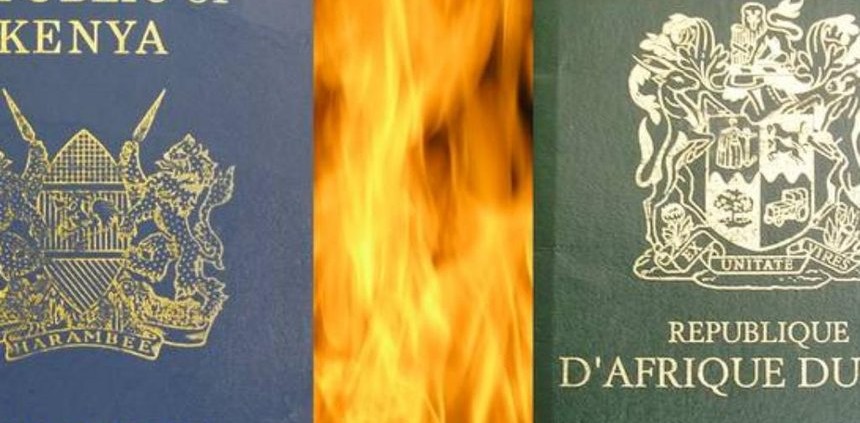
The South African government has announced measures to relax visa rules for Kenyan travellers as a fresh move to strengthen bilateral ties.

The measures announced on Tuesday will include visa exemption for holders of diplomatic and official passports, issuing of three-year multiple entry visa for frequent travellers, and a 10-year multiple entry visa for frequent business travellers and academics, the SA Department of Home Affairs (DHA) said.

South Africa will also issue study visas for the duration of study (including extending permanent residence to those studying within the critical skills category) and remove transit visas for travellers transiting through South African airports, the DHA said in a statement.

Service fee for visa applications will be cut from 71$ (Sh7177.14) to 49$ (Sh4953.24), the department said.

The DHA made the announcement as SA Minister of Home Affairs Malusi Gigaba was paying a three-day visit to Kenya.

Gigaba held talks with Kenyan officials on bilateral, regional and multilateral issues of mutual interest, including updating each other on the various respective initiatives being undertaken to fight trans-national crimes such as terrorism, drug-trafficking, illegal arms, money-laundering and illegal migration.

“These are issues that continue to be constraints on implementing free movement of travellers,” it said. Endit.

This comes after two years of back and forth between the two countries placing meausre on issuance of visas making it almost impossible for ordinary citizens of these economic powerhouses to visit each other, than it would be for either country’s citizens to visit Britain or the United States.

South Africa introduced a raft of changes to its visa regime in 2014 May making it impossible for all foreigners to renew their visas within its borders, of course with the exception of Zimbabweans under the special dispensation regime.

Two weeks later in June, Kenya responded proposing strict conditions effective from 1 September 2014 which only targeted South Africans travelling into and transiting through the East African country.

Kenya has not been issuing visas to South Africans at the port of entry making South Africans wait for a week before travelling into or transiting through Kenya.

http://www.the-star.co.ke/news/2016/05/04/south-africa-announces-plans-to-relax-visa-rules-for-kenyan-travellers_c13440661344067