THREE MINUTES. FIVE HOURS.
Dept.-of-Home-Affairs

Three minutes. That’s how long it took Home Affairs to process my passport application on Friday. The efficiency disoriented me. Mainly because I’d been queuing for five hours.
Relocation Immigration
I’ll spare you the story about the One Queue for the One Person at the One Desk. Actually, that’s the whole story. That’s why it took me an hour to get off the pavement and into the building.

I also won’t tell you about the poster they’ve stuck up on every square inch at Home Affairs, because I still don’t know what it means. It’s a picture of a rusty clock with the words, “When the rate of change outside exceeds the rate of change inside, the end is in sight.”

What? Is it about grilling cheese, where you want the outside to be nice and brown but the inside must still be runny? Is it possible that Home Affairs’ mission statement is a snackwich? Actually, given what I witnessed over those five hours, it might be.

As for how it took me two hours to pay for my application, well, I can’t tell you that because I can’t remember most of it. But I can remember what happened next.

It was just after 11 in the morning and I was watching a bead of sweat. It was slowly gathering on the back of the neck of the man in front of me, and I was wondering how big it could get before it ran down into his shirt collar. But I never got to see it trickle because then .

At first it was just a ripple of alarm, moving through us like a gust through leaves. But soon it became a word: “Offline”.

The System was Down.

I don’t know how the information spread at first, because there was no announcement from any of the officials, at least nothing involving human words. Luckily for us, though, their body language spoke volumes. And the way they sighed happily, slumped into their chairs and started grazing on muffins told us that our afternoon had just been shot to hell. Babies began to wail.

A few in the queue become indignant. Poor fools. They still didn’t understand. They still didn’t know where they were.

They got up and marched away to the One Queue. But they soon returned, ashen faced and shaking.

“You can leave,” one whispered, “but if you leave you have to start the whole process again.” They sat down quietly, and didn’t speak again. They had learned.

She was a mirage; a trick of the neon light

Half an hour passed. More muffins. An hour. Noon. The babies were no longer crying: in this desert of time, they had aged into teenagers and were now lolling across three chairs and telling their parents that they hated them.

Two hours. The old people fanned their faces with pieces of paper and waited for death.

Nobody noticed when the clerk stood up. When she asked for our attention, only a few people turned to look. The rest ignored her. She was a mirage; a trick of the neon light; a hallucination conjured by the stale air. Nobody was coming. Nobody would ever come.

But she was real, and she had brought word about the System. The System, she said, was online. We blinked back at her. Yes, she said, it was working. Maybe. Nobody was sure. It was important not to get excited. False hope could be worse than despair. That was when people did reckless things, like trying to hike out alone to get help, or making lunch plans. But, she said softly, there was a chance that the System was online again. They were going to try to process a few more applications, and if they failed, well . She flapped her hand, palm up to palm down and back again, and sat down.

It was a gesture of total surrender, her hand transformed into a lotus flower drifting down the endless river of life, sometimes going this way, sometimes that. It asked: Which of us really knows anything? Who would try to plan a life when all is chance?

In that moment I was filled with the great calm that comes from giving up; the peace of Government that passeth all understanding. I felt part of the vast beating heart of the civil service, and I understood that my application would either be processed or it wouldn’t, but that either way bureaucrats would have their muffins and go home at 4pm.

Just then I felt I was ready to wait for days, weeks, years, a lifetime. All would unfold in its own time.

And just as I was ready to leave everything behind and surrender my soul to Home Affairs, the computers woke up.

They called my number.

180 seconds later I was done.

I walked, blinking, into the afternoon sun. Three minutes. Five hours.
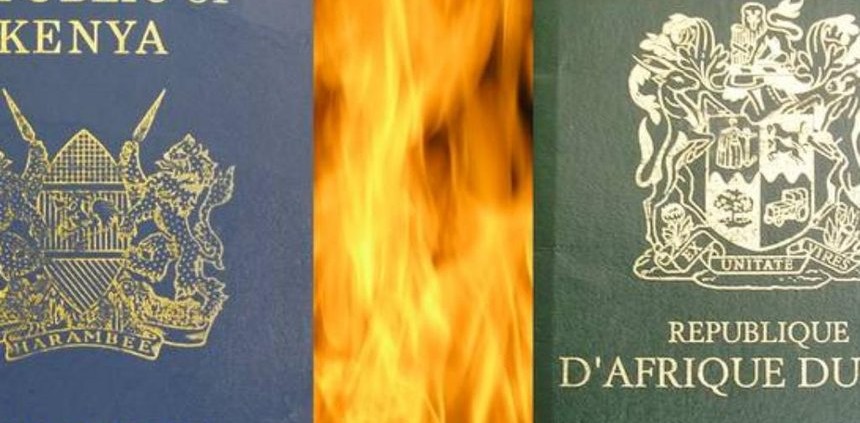
The South African government has announced measures to relax visa rules for Kenyan travellers as a fresh move to strengthen bilateral ties.

The measures announced on Tuesday will include visa exemption for holders of diplomatic and official passports, issuing of three-year multiple entry visa for frequent travellers, and a 10-year multiple entry visa for frequent business travellers and academics, the SA Department of Home Affairs (DHA) said.

South Africa will also issue study visas for the duration of study (including extending permanent residence to those studying within the critical skills category) and remove transit visas for travellers transiting through South African airports, the DHA said in a statement.

Service fee for visa applications will be cut from 71$ (Sh7177.14) to 49$ (Sh4953.24), the department said.

The DHA made the announcement as SA Minister of Home Affairs Malusi Gigaba was paying a three-day visit to Kenya.

Gigaba held talks with Kenyan officials on bilateral, regional and multilateral issues of mutual interest, including updating each other on the various respective initiatives being undertaken to fight trans-national crimes such as terrorism, drug-trafficking, illegal arms, money-laundering and illegal migration.

“These are issues that continue to be constraints on implementing free movement of travellers,” it said. Endit.

This comes after two years of back and forth between the two countries placing meausre on issuance of visas making it almost impossible for ordinary citizens of these economic powerhouses to visit each other, than it would be for either country’s citizens to visit Britain or the United States.

South Africa introduced a raft of changes to its visa regime in 2014 May making it impossible for all foreigners to renew their visas within its borders, of course with the exception of Zimbabweans under the special dispensation regime.

Two weeks later in June, Kenya responded proposing strict conditions effective from 1 September 2014 which only targeted South Africans travelling into and transiting through the East African country.

Kenya has not been issuing visas to South Africans at the port of entry making South Africans wait for a week before travelling into or transiting through Kenya.

http://www.the-star.co.ke/news/2016/05/04/south-africa-announces-plans-to-relax-visa-rules-for-kenyan-travellers_c13440661344067

Since I am an only child, my parents were the first best friends I ever had, and they were also the most financially generous. As a child, I used to call my mom “Anne” and my dad “Steve” perhaps because I saw them more as my friends than as my parents.

People always commented about how close we were and at the time I don’t believe any of us thought we could get any closer.

One day on a quiet Tuesday afternoon, my mother and father sat me down and asked how I would feel about moving to the United States. My first thought, being an 11-year-old girl was: Britney Spears lives there, they have Bonnebell Lipsmackers and really good ice-cream flavors like cookie dough, so I would like to live there too.

We started the daunting immigration process and within a few months we found ourselves living in Las Vegas, Nevada. We had my dad’s family who I just met for the first time but other than that we had no friends, no familiar faces and definitely no familiar foods. We only had each other.

So how did it make us closer you might wonder? It made us closer because I immigrated at an age where adolescents typically push away their parents. I had no choice but to stay close to mine because they were all that I had.

Instead of going to the movies or bowling with my friends, I stayed home on weekend nights and watched game shows with them. At the time, I felt sort of like a loser, but looking back on it, those were some of my most fun and most memorable nights I have had. And those were the nights that got us through immigration.

If your family is considering immigrating or has made the brave move, here are a few tips on how to rely on your family to get you through. Read more click on the link below

http://www.thesouthafrican.com/how-my-family-got-me-through-the-immigration-process/

HomeAffairs in Court2 Groundup
Concern over withdrawal of rights of asylum seekers and refugees
Immigration lawyers have accused the Department of Home Affairs of being in contempt of a High Court order. This comes after the department withdrew an instruction allowing asylum seekers and refugees to apply for permanent residence without giving up their asylum or refugee status. The Department also withdrew an instruction allowing asylum seekers and refugees to apply for temporary residence without a valid passport.
Temporary residence visas include relatives’ visas and work visas.
“The effect of this is huge, as asylum seekers are struggling to get married and register the birth of their children with South African spouses,” the Forum of Immigration Practitioners said.
Another effect was that asylum seekers who did not have temporary residence could not open a bank account, FIPSA said. This made them vulnerable to crooks who preyed on them because they carried cash.
The directive signed by Mkuseli Apleni on 3 February 2016 explains that the Department believes that asylum seekers (who are yet to be granted refugee status) should not have their status changed, for example given permanent or temporary residence, until they are certified as refugees. Following this logic, the Department has withdrawn a circular of 2008 which had allowed asylum seekers to apply for permanent residence.
In the directive, Apleni, who is Director General of Home Affairs, states, “I wish HomeAffairs in Courtto advise all immigration officials thatDepartmental Circular No. 10 of 2008 has fallen away since the 26th of May 2014 and is hereby officially withdrawn. All applications for change of status from asylum seeker permit to temporary residence visa which are still pending in the system should be processed as per this directive regardless of the date of application”.

Apleni’s directive comes in spite of a 2003 Western Cape High Court order. In the matter of Dabone and others vs the Minister of Home Affairs, the court instructed that asylum seekers and refugees should be able to apply for temporary residence permits and permanent residence without having to cancel their asylum seeker status or give up their refugee status.
Another important provision of the court order was that asylum seekers or refugees do not need to be in possession of a valid passport for their temporary residence permits to be processed or issued.
FIPSA said the Department’s new directive was “breaking the law” by deviating from the court order.
“The Dabone Judgement is in fact a consent order of court which means that as parties to the agreement the Department of Home Affairs have agreed to it and that it is binding. As such it cannot be appealed to a higher court and any deviation thereto constitutes a contempt of court,” said FIPSA.
FIPSA also said that VFS, which is the company that processes visa documents, had stopped accepting applications for temporary or permanent residence from refugees or asylum seekers.
FIPSA and other interested parties are to take the Department to court on 21 April 2016, with Tashriq Ahmed representing them. FIPSA told GroundUp that the Department had said it would defend the matter. “But it is a consent order, so it is inconceivable what defence they can mount. As we have seen before, Home Affairs have a pattern of just appealing matters to frustrate clients as justice is expensive, in the hope clients will run out of money.”
FIPSA said asylum seekers and refugees were vulnerable and few organisations took up their battle to win their rights under the constitution.
The Department’s spokesperson promised on Friday to respond to questions but has not yet done so.